The Effect of Fatigue on the Patellar Reflex
This summer, I took an Intro to Neuroscience class at UChicago. As part of the class, my group (Fatigue Factory Inc.) decided to test whether fatigue impacts the speed of your patellar reflex (aka the knee-jerk).
When a doctor taps just below your kneecap, this stretches your quadriceps (large muscle on the front of your thigh). The stretching causes a specialized proprioceptive muscle spindle to send a signal to your spinal cord, which then sends a signal back to your quadriceps, causing it to contract. The quickness of this response is very quick, requiring little brain processing.
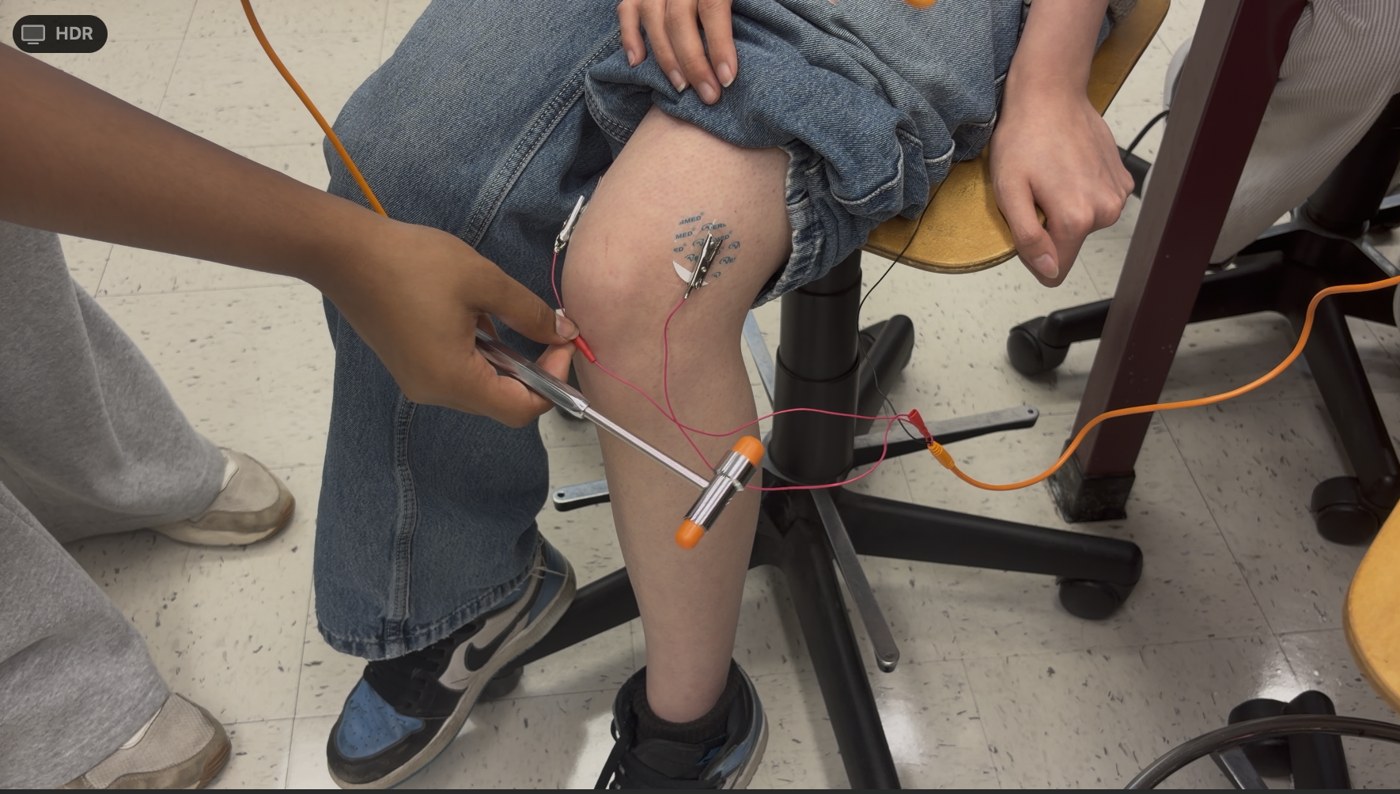
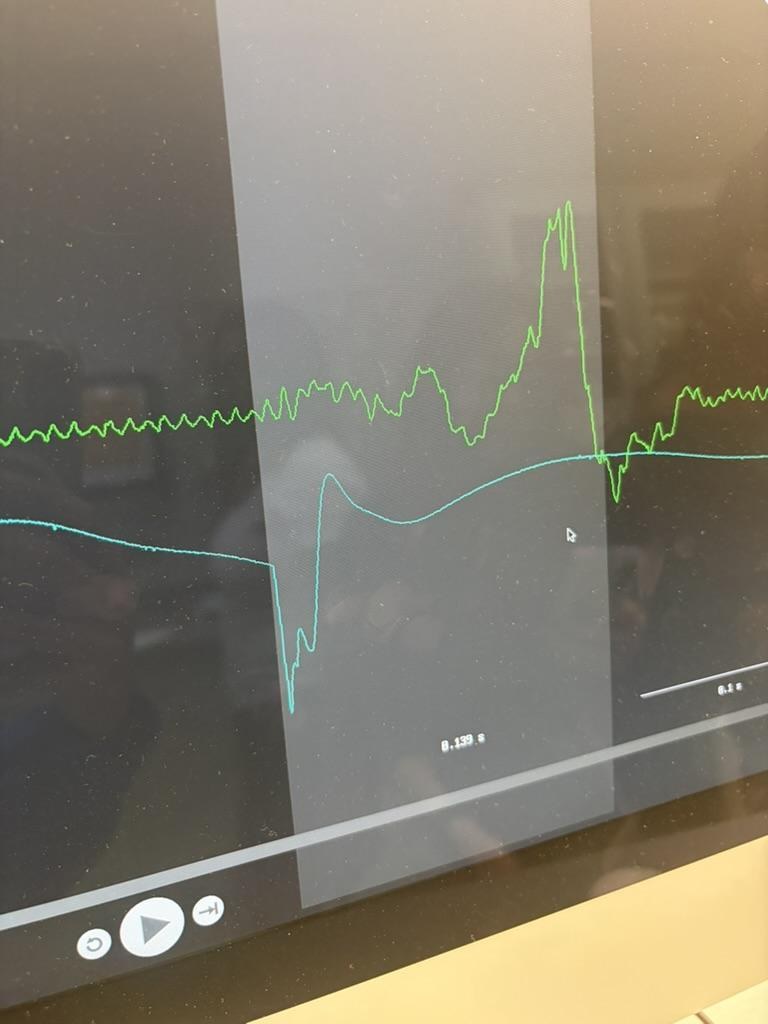
For our experiment, we decided to test whether the speed of our reflexes would change depending on how worn out our legs were. We hypothesized that yes, being more worn out would affect the speed of our reflexes. To do this, we attached electrodes to either side of one of our classmate's quadriceps and attached them to an amplifier called a spikerbox, where we were able to measure the voltage readings. We began by tapping the tendon below her kneecap with a reflex hammer to establish her baseline knee jerk. Next, our classmate did lunges for 30, 60, and 90 seconds while we tested her reflexes immediately after. We also tested the effect of running as opposed to lunges, in order to see if different exercises produce different results.
Ultimately, our hypothesis was not supported. Neither lunges nor runs seemed to have a significant effect on the speed of her knee-jerk, although several of our data points did show signs of a possible increase in speed. For instance, one of my classmate's tests showed an increase in voltage right after 60 seconds, then again decreased at 90 seconds, possibly establishing some sort of pattern of adaptation. As a group, we noticed that while the speed of the knee-jerk did not change, the voltage decreased as her muscles became more fatigued. Perhaps the patellar reflex is a resilient response, and it maintains most of its power regardless of fatigue until the muscles are absolutely exhausted.
While we do not have strong evidence to support our original hypothesis, there is possible evidence that the knee-jerk does slightly decrease in power (voltage) as the muscles become more tired. In order to test this further, we might want to take readings from many more participants, as well as increasing the amount of time spent exercising.